AI & future of work6 min read
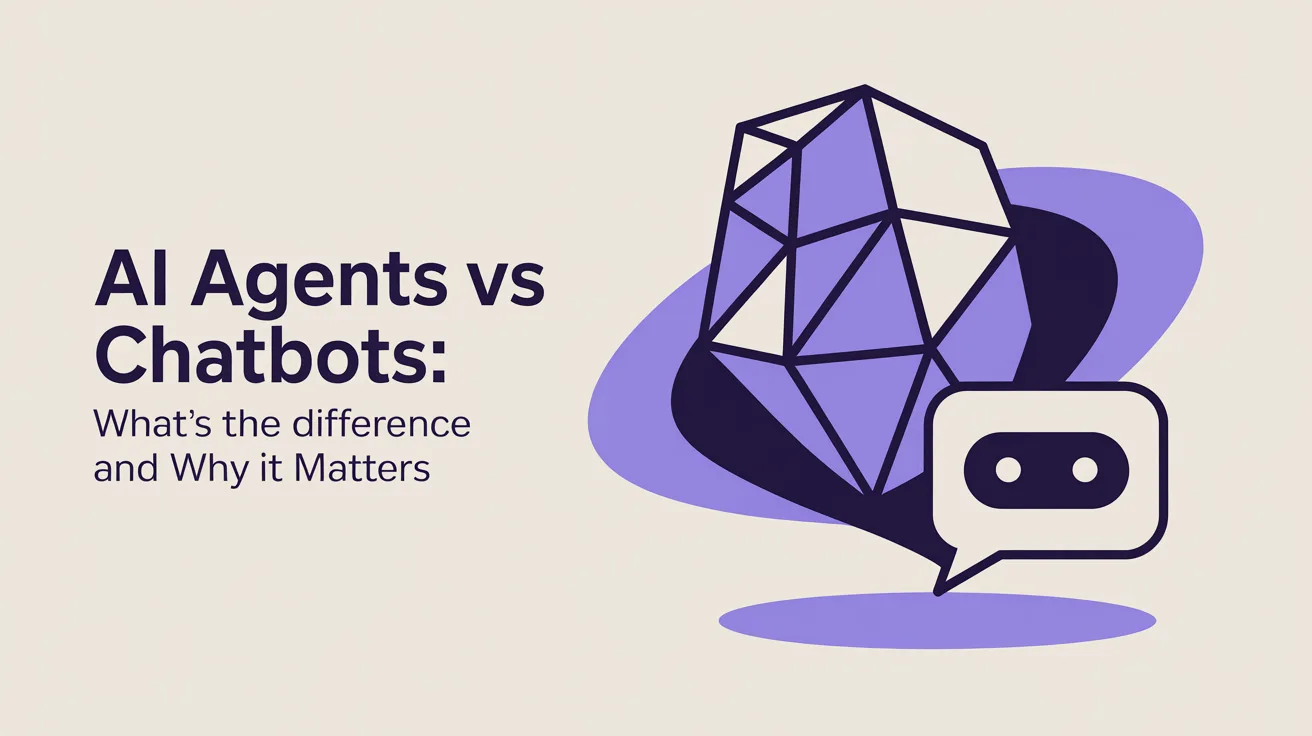
AI Agents vs Chatbots: What's the Difference and Why It Matters

You’re building an AI-powered app, and you’re stuck on one question: Should you use a chatbot or an AI agent? It’s a big decision. Chatbots are everywhere, but AI agents are the new buzzword. What’s the real difference between them — and why does it matter for your project?
The AI agents vs chatbots difference boils down to this: chatbots answer questions; AI agents solve problems. A chatbot is like a helpful receptionist. It responds to your questions, retrieves information, and follows a script. An AI agent? Think of it as a digital coworker. It doesn’t just talk — it plans, makes decisions, and takes action across multiple systems.
This distinction isn’t just academic. Choosing the wrong one can leave your app feeling clunky or limited. Let’s break it down.
Key takeaways
- Chatbots are reactive, answering questions within a conversation. AI agents are proactive, completing goals and tasks autonomously.
- Chatbots handle simple interactions well; AI agents excel at multi-step workflows and decision-making.
- AI agents integrate with tools, APIs, and databases, while chatbots usually don’t.
- For complex tasks like managing campaigns or automating workflows, AI agents are the better choice.
What is a chatbot?
A chatbot is a program designed to simulate human conversation. It’s like a digital receptionist — great at answering FAQs, booking appointments, or retrieving simple information. Most chatbots today use large language models (LLMs) like GPT to generate natural-sounding responses, but their core function remains the same: reacting to user inputs.
For example, if you ask a chatbot, “Where’s my order?” it’ll check a database and return a tracking number. It’s straightforward, predictable, and effective for simple tasks.
Where chatbots shine
Chatbots are widely used in:
- Customer service FAQs
- IT helpdesk bots
- Booking and reservation systems
- Internal company knowledge assistants
The limitations of chatbots
While chatbots are useful, they have clear boundaries. They struggle with:
- Complex questions that require reasoning
- Off-script queries that fall outside their programmed responses
- Independent action — chatbots only respond to inputs; they don’t act on their own
What is an AI agent?
An AI agent is a step up from a chatbot. It’s like a smart intern or virtual coworker. Instead of just responding to questions, it thinks, reasons, learns, and takes action. AI agents are powered by advanced machine learning models and can integrate with APIs, tools, and databases to complete multi-step workflows.
For example, if a customer says, “My package hasn’t arrived, and I need it before Friday,” an AI agent can:
- Check the order status
- Review shipping options
- Upgrade the shipping if permitted
- Notify the customer of the resolution
It doesn’t just answer a question — it solves the problem.
Real-world AI agent examples
AI agents are transforming industries:
- Marketing: Writing emails, managing campaigns, tracking performance
- E-commerce: Managing inventory, order flows, and personalized recommendations
- Finance: Monitoring data feeds, executing trades, sending alerts
- Customer Success: Handling nuanced B2B support across channels
Chatbot vs AI agent comparison
Here’s a side-by-side look at the key differences:
| Category | Chatbot | AI Agent |
|---|---|---|
| Primary Purpose | Answer questions | Complete goals and tasks |
| Behavior | Reactive | Proactive |
| Decision Making | Limited | Advanced |
| Memory & Context | Short-term | Maintains context across tasks |
| Tool Usage | None | Uses APIs, tools, and databases |
| Task Complexity | Simple interactions | Multi-step workflows |
| Learning | Limited | Adaptive |
AI moves fast. Know which fundamentals to learn first.
Useful AI work still runs on ordinary programming. Answer 7 questions and see where you are on that path, and what comes next for you.
- What to focus on right now
- What you can safely ignore for now
- A first project at your level
- A weekly plan that fits your time
Free · About 2 minutes · No signup
Already learning? Check where your skills are or build a small app
Benefits of AI agents over chatbots
AI agents offer several advantages:
- Proactivity: They don’t wait for inputs; they initiate actions based on goals.
- Adaptability: They learn from new data and adjust to changing inputs.
- Integration: They connect with APIs, tools, and databases to complete complex tasks.
- Autonomy: They handle end-to-end workflows with minimal human intervention.
For example, while a chatbot might answer a customer’s question about their order status, an AI agent could resolve the entire issue — from checking the order to upgrading shipping and notifying the customer.
When to use an AI agent instead of a chatbot
Not every task needs an AI agent. Here’s how to decide:
Use a chatbot when:
- The task is simple and repetitive (e.g., answering FAQs)
- You only need to retrieve or display information
- The workflow follows a predictable script
Use an AI agent when:
- The task requires reasoning or decision-making
- You need to integrate multiple tools or systems
- The workflow is complex and multi-step
- The goal is to solve a problem, not just answer a question
For example, building your first coding project might start with a chatbot for FAQs, but automating workflows or managing campaigns would likely require an AI agent.
AI agent examples in action
Let’s look at two more scenarios:
Example 1: Marketing
A chatbot can answer questions about campaign performance. An AI agent can analyze data, optimize ad spend, and generate weekly performance reports — all without human intervention.
Example 2: Career coaching
A chatbot might provide generic resume tips. An AI agent can analyze a job posting, tailor a resume, and even draft a cover letter tailored to the role.
These examples show how AI agents go beyond conversation to deliver real-world results.
Why this difference matters for aspiring developers
Understanding the AI agents vs chatbots difference isn’t just technical — it’s strategic. Here’s why:
- Choosing the right tool: Building an AI agent for a simple FAQ bot would be overkill. Conversely, using a chatbot for complex workflows will frustrate users.
- Career opportunities: Employers are increasingly looking for developers who can design intelligent workflows and automate decision-making processes.
- Future-proofing: As businesses shift toward AI-first operations, the demand for AI agents is growing exponentially.
If you’re learning AI development, mastering both tools gives you a competitive edge. Start with coding basics, then explore how AI can enhance your projects.
The future of AI agents vs chatbots
Chatbots helped introduce AI to the mainstream. AI agents are taking it to the next level. They’re not just answering questions — they’re solving problems, automating workflows, and transforming industries.
The question isn’t whether AI agents will replace chatbots. It’s when and where each tool fits best. For simple interactions, chatbots are efficient and cost-effective. For complex tasks, AI agents are the clear choice.
Ready to dive deeper? Check out our guide on what AI agents are and how they work. Or, if you’re just starting your coding journey, explore our beginner’s guide to learning programming.
The future of AI isn’t just about answering questions — it’s about building systems that can get work done. And that’s where AI agents shine.
Frequently asked questions
What is the main difference between AI agents and chatbots?
Chatbots answer questions reactively, while AI agents proactively solve problems by planning, making decisions, and taking actions across systems.
When should I use an AI agent instead of a chatbot?
Use an AI agent for tasks requiring reasoning, multi-step workflows, or integration with tools and APIs. Chatbots are better for simple, repetitive tasks like answering FAQs.
Can AI agents learn and adapt over time?
Yes, AI agents are adaptive and can learn from new data, adjusting their behavior to handle changing inputs and tasks.
What are some real-world examples of AI agents?
AI agents are used in marketing to optimize campaigns, in e-commerce to manage inventory, and in finance to monitor data feeds and execute trades.
Do chatbots integrate with APIs and databases?
No, chatbots typically do not integrate with APIs or databases. AI agents, however, connect with tools, APIs, and databases to complete complex tasks.
Why is understanding the difference between AI agents and chatbots important for developers?
Knowing the difference helps developers choose the right tool for their project, opens career opportunities in AI workflows, and future-proofs their skills as demand for AI agents grows.