Learn to code6 min read
Reasons People Fail to Learn Coding (And How to Improve)

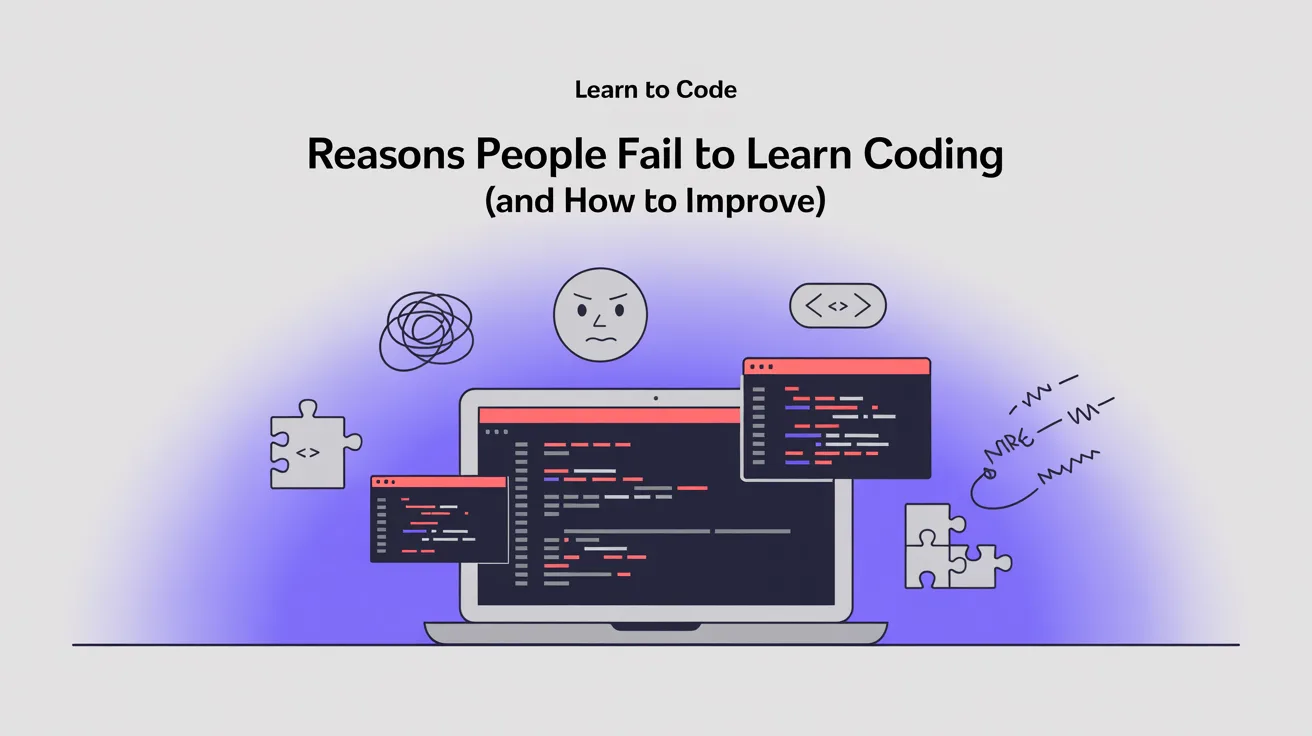
Most people who quit coding do not quit because they are bad at logic. They quit because they spent three months collecting information instead of building things. That is the short answer to why people fail to learn coding: passive input, no output, no plan, and a reliance on motivation that runs out around week five.
The fix is mechanical. It is not a personality transplant.
Key takeaways
- Learning how to program — loops, conditionals, functions, arrays — transfers between languages. Syntax does not. Spend your first month on the concepts, not on choosing between Python and JavaScript.
- Watching a tutorial teaches you recognition. Writing code from a blank file teaches you recall. Only one of those gets you hired.
- Motivation lasts about as long as the novelty. A fixed 45-minute slot four nights a week beats a 6-hour Saturday binge you cancel twice a month.
- Every hour of tutorial should be followed by at least an hour of you typing code with the video closed.
Why people fail to learn coding: the four traps
The traps are predictable. I have watched hundreds of career-changers walk into the same four.
Trap one: learning a language before learning to program. You pick Python, memorise for loop syntax, then open a blank file and freeze. That is not a Python problem. You never learned to break a task into steps.
Think about spoken languages. English runs subject-verb-object. Japanese runs subject-object-verb. Once you understand what a subject and a verb are, learning a second language is swapping order and vocabulary. Programming works the same way — the logic is the grammar, and the language is just vocabulary. This is exactly why experienced developers can pick up a new programming language in a couple of weeks.
Trap two: memorising instead of practising. Coding is closer to maths than to history. Nobody gets good at algebra by re-reading worked solutions, and nobody gets good at code by re-watching someone else write it. You need friction — the actual moment where you don't know what comes next and have to think it through. Skip that moment enough times and you end up with a library of patterns you can recognise but can't produce.
Trap three: relying on motivation. Excitement gets you to lesson three. Discipline gets you to a portfolio. The people who make it aren't more passionate about code than the people who quit — they just stopped waiting to feel like it. They show up on a schedule, the same way you'd show up to a gym class you already paid for.
Trap four: avoiding hard things. "I'll try authentication when I'm better." You get better by trying authentication and failing at it for a weekend. Skipping the hard part doesn't make you less ready for it later. It just moves the same struggle to a worse moment — usually a job interview.
This article is one step. See the whole path for you.
What you learn matters less than learning it in an order that builds. Answer 7 questions and see the path that fits your goal, your level and the hours you have.
- What to focus on right now
- What you can safely ignore for now
- A first project at your level
- A weekly plan that fits your time
Free · About 2 minutes · No signup
Already learning? Check where your skills are or build a small app
Why is learning to code so hard, really?
Software development keeps showing up on lists of durable, well-paid careers — the U.S. Bureau of Labor Statistics projects continued demand for software developers over the coming decade — and that's a big part of why so many career-changers pick it up in the first place. But the difficulty itself isn't really about the subject matter.
It's the feedback. Coding gives you instant, unforgiving feedback in a way almost nothing else in adult life does. A typo in an email still gets read. A typo in code gets you nothing — a blank page, a red error, silence. Most skills adults pick up as beginners — cooking, public speaking, even a new language spoken aloud — come with fuzzy, forgiving feedback. Code doesn't negotiate.
That's what makes it feel harder than it is. You're not bad at logic. You're just unused to a skill that tells you, immediately and precisely, exactly when you're wrong.
Common reasons people quit coding, ranked by how often I see them
| Reason | What it looks like | What's actually wrong |
|---|---|---|
| Tutorial hell | 40 videos watched, 0 projects built | No output, so no feedback |
| Language hopping | Python week 1, Go week 3, Rust week 5 | Avoiding the discomfort of getting stuck |
| No roadmap | "I'll learn React... and also SQL... and also Docker?" | No defined finish line |
| All-or-nothing schedule | 8 hours Sunday, nothing Mon–Sat | Progress evaporates between sessions |
| Comparing to 19-year-olds on Twitter | "Everyone's ahead of me" | Wrong benchmark entirely |
The first one is so common it has a name. If you recognise yourself in it, read why you can't code after finishing tutorials.
Coding learning mistakes to avoid: a worked example
Here is what practice actually means. Say you've just learned arrays and loops. A tutorial shows you this:
const cart = [12, 8, 30];
let total = 0;
for (const price of cart) {
  total += price;
}
console.log(total); // 50
Adds every price in an array and prints the sum. You watch it, you nod, it makes sense. Making sense is not the same as being able to write it.
So close the tab and do this:
- Open a blank file. Write that loop from memory. You will get something wrong — probably forgetting to declare
totaloutside the loop. Good. Now you know it. - Change the goal: add 6% tax to the total.
- Change it again: skip any single item over 50 — maybe you're modelling a discount cap.
- Now rewrite the whole thing using
.reduce()instead of aforloop. Look up the syntax in the MDN docs if you need to — that's not cheating, that's what documentation is for. Copying working code without ever attempting your own version first is the actual mistake.
Each version breaks something you thought you understood. That break is the practice. The tutorial was never going to give it to you.
How to not give up learning programming
None of this takes more willpower. It takes structure you don't have to invent yourself: a fixed roadmap, a fixed schedule, and someone checking whether you actually built the thing or just watched someone build it.
If you're piecing that structure together on your own, expect it to wobble around week five — that's when motivation runs out and only the schedule keeps you moving. That's the entire model behind ZAM Academy's bootcamp: projects instead of playlists, and a schedule that doesn't ask you to feel motivated on a Tuesday night.
Start smaller than a bootcamp if you want to test the approach first. Pick one project, close every tutorial tab, and build it from a blank file this week.
Frequently asked questions
Why do most people fail to learn coding?
They spend months passively watching tutorials instead of writing code themselves, so they never get the feedback that comes from building things.
Is it better to learn programming concepts or a specific language first?
Learn concepts first. Loops, conditionals, functions and arrays transfer between languages, but syntax does not.
How long does motivation last when learning to code?
About as long as the novelty lasts, often only a few weeks. A fixed short schedule several nights a week works better than relying on motivation.
What is tutorial hell?
It's when someone watches many tutorials but builds zero projects, so they get no real practice or feedback on their skills.
How much practice should follow each hour of tutorial watching?
At least one hour of writing code yourself, with the tutorial video closed, for every hour of tutorial watched.
Why does switching programming languages often not fix learning struggles?
Jumping between languages like Python, Go and Rust is usually a way to avoid getting stuck, not a way to solve the underlying problem of not practicing.