Learn to code5 min read
Data Analytics vs Data Science: What's the Difference?

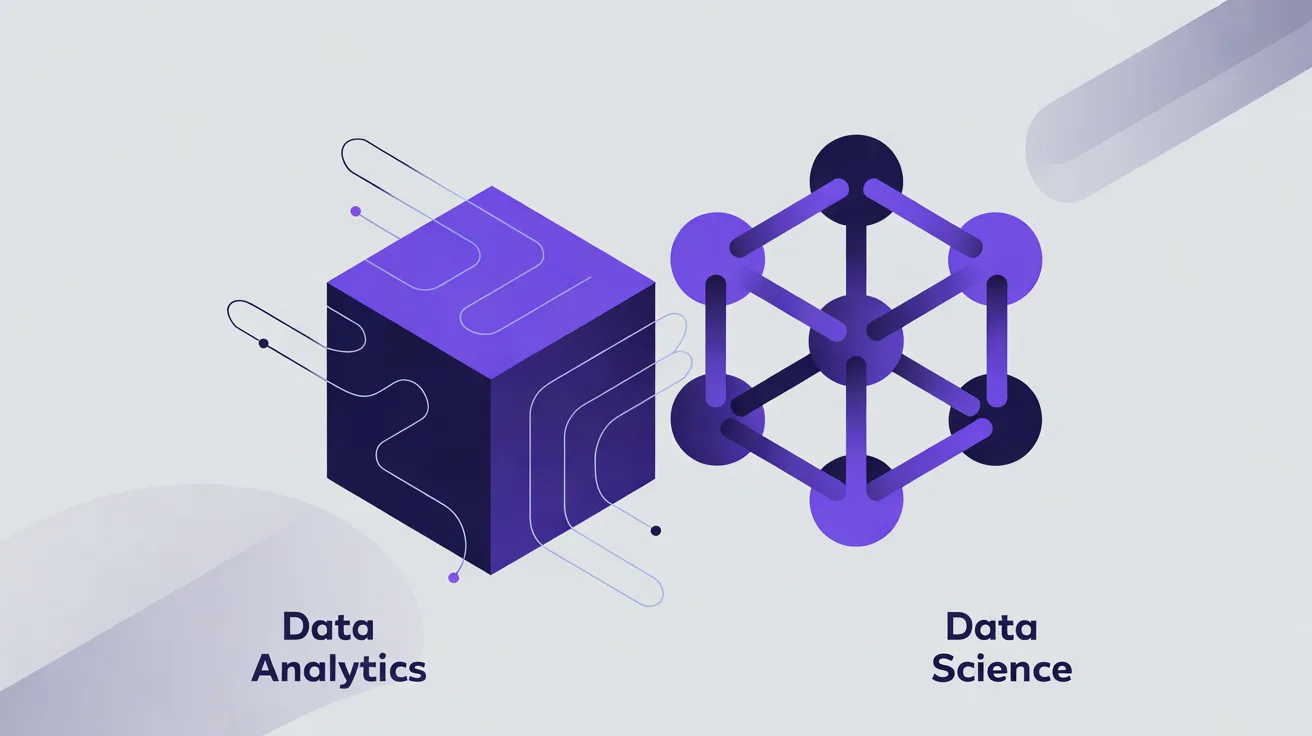
Data analytics vs data science comes down to direction. Analysts explain what already happened so a business can decide what to do today. Scientists build models that predict what happens next. One looks backward, the other forward, and that shapes the tools, the maths, and how hard each is to break into.
Key takeaways
- Analysts answer "what happened?" using SQL, Excel and a BI tool like Power BI or Tableau. Scientists answer "what happens next?" using Python and machine learning libraries such as scikit-learn.
- SQL is the one skill both roles share. A beginner can write useful queries within their first few weeks.
- The entry bar is different. Data science roles usually expect real statistics and often a master's degree. Analyst roles regularly hire bootcamp graduates and bachelor's holders.
- Most career-changers should start as an analyst. Many working data scientists got there that way: analyst first, then machine learning on top.
Data analytics vs data science in one sentence
Here's the version I give students on day one: an analyst turns data into a decision, and a scientist turns data into a prediction.
Take an online shop in Penang. Sales dropped 12% last month. The analyst's job is to find out why. Maybe it was one product category, one region, or a delivery partner that kept failing. The data scientist's job is to build something that flags next month's drop before it happens.
Both people stare at the same database. They ask it different questions.
What a data analyst actually does on a Tuesday
An analyst's week is a pile of business questions, often sent by someone who isn't technical:
- How did sales perform last quarter?
- Which customer segment buys most often?
- Why are users cancelling after the first month?
To answer them, the analyst collects and cleans raw data, hunts for patterns, builds a dashboard or report, and then explains it to the people who asked. That last step matters more than beginners expect. A brilliant chart nobody understands is worth nothing.
Most of the data is structured, meaning rows and columns in a database or spreadsheet. The workhorse is SQL. Here's the kind of query an analyst writes before lunch:
-- Total revenue per region for last quarter, highest first
SELECT region, SUM(order_total) AS revenue
FROM orders
WHERE order_date BETWEEN '2026-07-01' AND '2026-09-30'
GROUP BY region
ORDER BY revenue DESC;
Five lines. It answers a question a manager would otherwise spend a day guessing at in Excel. This is why I tell every career-changer to learn SQL first, whichever role they want. It pays off immediately.
This article is one step. See the whole path for you.
What you learn matters less than learning it in an order that builds. Answer 7 questions and see the path that fits your goal, your level and the hours you have.
- What to focus on right now
- What you can safely ignore for now
- A first project at your level
- A weekly plan that fits your time
Free · About 2 minutes · No signup
Already learning? Check where your skills are or build a small app
What a data scientist does with the same data
The scientist takes those orders and asks a harder, fuzzier question: which customers are about to stop buying?
Nobody hands them a clean spec for that. They design experiments, test hypotheses, and build machine learning models. They often work with unstructured data too, like product reviews, support chat logs and images. They may also build pipelines that pull fresh data in automatically, so the model stays current.
Here's a stripped-down taste of that work in Python:
# Train a model to predict whether a customer will churn (1) or stay (0)
from sklearn.linear_model import LogisticRegression

model = LogisticRegression()
model.fit(customer_features, churned)       # learn from past customers
risk = model.predict_proba(new_customers)   # score current customers by churn risk
Three lines of real logic. The hard part sits underneath them: picking the right features, knowing whether logistic regression even suits the problem, and spotting when the model is lying to you. The scikit-learn documentation is excellent, but it assumes you already understand the statistics.
The difference between data analyst and data scientist, side by side
| Data Analyst | Data Scientist | |
|---|---|---|
| Main question | What happened, and why? | What will happen, and what should we do? |
| Type of analysis | Descriptive, diagnostic | Predictive, prescriptive |
| Data | Mostly structured | Structured and unstructured |
| Daily output | Reports, dashboards, KPIs, presentations | Models, experiments, automated pipelines |
| Core tools | SQL, Excel, Tableau, Power BI | Python or R, scikit-learn, TensorFlow, PyTorch, Spark |
| Maths needed | Solid descriptive statistics | Probability, statistics, some linear algebra |
| Typical entry level | Entry to mid | Mid to senior |
| Usual route in | Bootcamp, certificate, or bachelor's | Bootcamp plus advanced study, often a master's |
| Where it leads | Senior analyst, BI, data science | ML engineer, data engineer, AI product roles |
If you only read one row, read "Main question." Everything else in the table follows from it.
Do data analysts need to code?
Yes, though probably less than you fear.
SQL is non-negotiable. Some people argue SQL "isn't real coding." I disagree. It's a programming language with logic, syntax, and very unforgiving error messages. If you've never thought about what a programming language actually is, our beginner-friendly guide to programming languages is a good ten-minute read.
Python or R is officially "optional" for analysts. In practice, it's becoming expected. The analyst who can write a small Python script to clean 40 messy CSV files beats the one who does it by hand every Monday. And if you're unsure what Python is good for beyond data, here's what Python is actually used for.
Here's a mistake I watch beginners make constantly. They learn SQL, write a query, get a number, and trust it completely. Then they find out a JOIN silently duplicated half the rows and the revenue figure is double the real one. Always sanity-check your output against something you already know. If last quarter's revenue suddenly looks like a record year, it's probably your query, not a miracle.
If you'd rather learn SQL and Python on a structured path with a mentor than piece it together alone, take a look at the ZAM Academy bootcamp.
Data scientist skills required, and the one people underestimate
The list is longer and steeper:
- Programming: Python is the default. R is common in research-heavy teams. Java or Scala show up in big data work.
Frequently asked questions
Do data analysts need to know how to code?
Yes, but mainly SQL, which is the one non-negotiable skill. Python or R is officially optional, though it is increasingly expected, for example to clean many messy files with a script.
Which tools does each role use most?
Analysts mostly use SQL, Excel and BI tools like Tableau or Power BI. Data scientists mostly use Python or R with libraries such as scikit-learn, TensorFlow or PyTorch, plus Spark for big data.
Is data science harder to get into than data analytics?
Generally, yes. Data science roles usually expect solid statistics and often a master's degree, while analyst roles regularly hire bootcamp graduates and people with a bachelor's degree.
Should a career-changer start as a data analyst or a data scientist?
Most career-changers should start as an analyst. Many working data scientists began that way, then added machine learning on top of their analytics experience.
What kind of data does each role work with?
Analysts mostly work with structured data, meaning rows and columns in databases or spreadsheets. Data scientists use structured data too, but also unstructured data like product reviews, chat logs and images.
What can a data analyst move into later in their career?
Analysts can progress to senior analyst or business intelligence roles, or move into data science. Data scientists can lead on to ML engineering, data engineering or AI product roles.