Learn to code8 min read
What Is Python Used For?

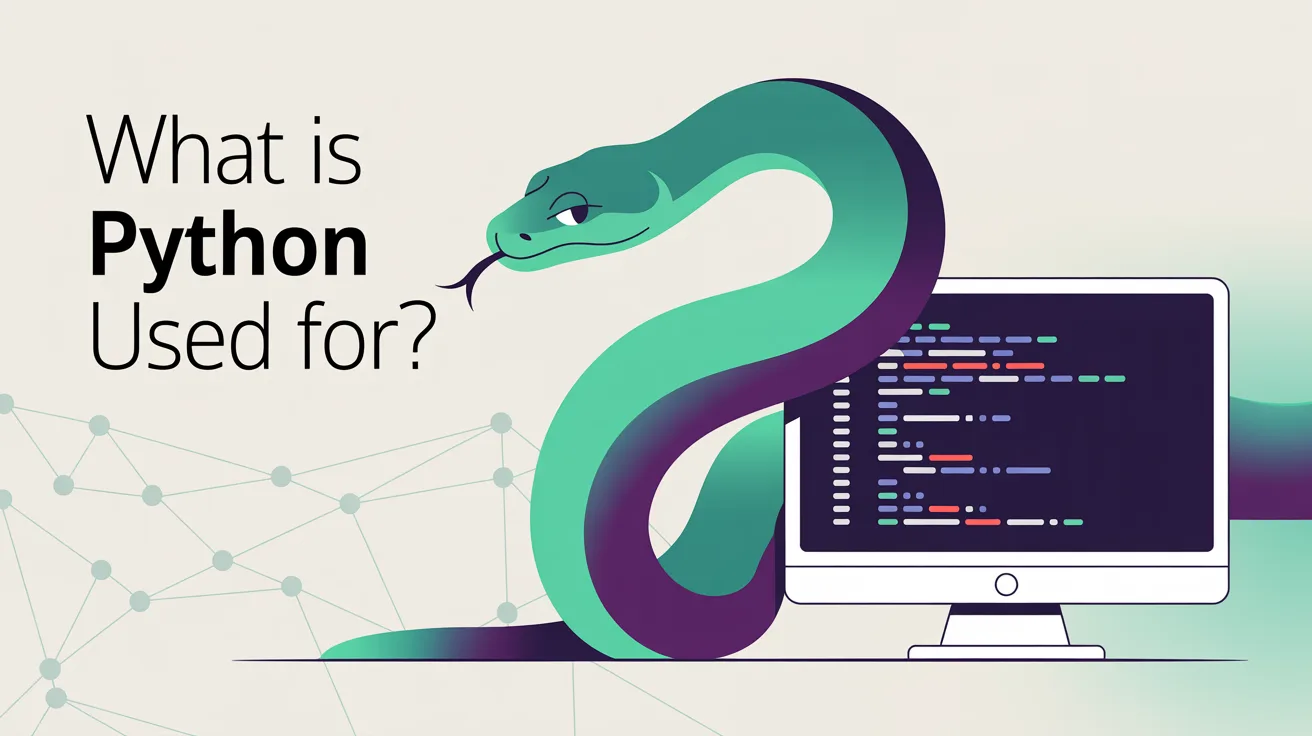
What is Python used for in programming? Automation, web backends, data science, AI, and finance — that's the short list, and it's why the language keeps showing up on every job posting you've scrolled through tonight. Python is readable enough for beginners and powerful enough for production. That range is rare. It's why so many career-changers start here.
Python is used for automation and scripting, web backend development (Django/Flask), AI and machine learning (TensorFlow, PyTorch), data science (Pandas, NumPy), and finance/quant work. It's popular because it's readable, fast to prototype in, and backed by huge libraries — which is also why so many beginners choose it as a first language.
What Is Python Used For in Programming? Automation First
You have 500 CSV files sitting in a folder. Each one needs to be renamed, have its headers cleaned up, and merged into a single database. Doing that by hand takes days. A Python script does it in minutes.
This is where Python earns its reputation as the default answer to "what is Python used for in programming." You write a script that handles file operations, extracts and validates data, then moves it somewhere else. The script runs once, or runs on a schedule. The work happens without anyone touching a keyboard.
Real example: a marketing team uses Python to download daily analytics reports from Google Ads, clean the data, and email summaries to stakeholders. Every morning, the report is there. No one manually ran it.
Here's the mistake I watch new students make constantly: they want to skip straight to machine learning before they've written fifty small scripts like this one. They end up rewriting the same for-loop five different ways because they never built the basic muscle memory. Automation is boring compared to AI headlines, but it's exactly where that muscle memory gets built.
Automation extends to the web too. Python scripts scrape websites, fill out forms, send emails on a schedule, check if systems are still running. DevOps engineers use Python constantly for this — watching logs, restarting services, provisioning servers. The appeal is obvious: repetitive work disappears. You stop being the person who runs reports and start being the person who built the system that runs them.
Web development and backend systems
Netflix, Spotify, Instagram, Dropbox, YouTube — all of them use Python on their backend. That's the part you never see: the servers, databases, the code handling your requests when you click "play" or "upload."
A backend engineer writes Python code that receives requests from your browser or phone, queries the database, processes the data, and sends the response back. Python has two main frameworks for this: Django (larger, more built-in) and Flask (smaller, more flexible). Most Malaysian startups use one or the other.
Here's what that looks like:
@app.route('/user/<int:user_id>')
def get_user(user_id):
    user = User.query.get(user_id)
    return jsonify(user.to_dict())
Someone hits /user/42, and Python returns that user's data as JSON. Simple. Readable. Scalable to millions of requests. This is why every backend engineer, full-stack developer, and DevOps role in Malaysia lists Python. If you want to build the systems people use — not just the interfaces they see — Python is the standard tool.
AI and machine learning
TensorFlow, PyTorch, LangChain, Hugging Face — the libraries powering AI are all built around Python. If you want to train a machine learning model, build a chatbot, or work with large language models, you're writing Python.
The reason is practical: AI researchers and engineers need to iterate fast. Python's simplicity lets them experiment. They can try a new neural network architecture in an afternoon instead of a week.
Real example: a fintech company in Kuala Lumpur uses Python to train a model that flags fraudulent transactions. The model sees millions of transactions, learns patterns, and flags suspicious ones in real-time. Another example: customer service chatbots. A hotel chain uses Python with a large language model to answer guest questions 24/7. When the model gets things wrong, the team retrains it — in Python. If AI/ML is your target, Python is non-negotiable. You'll start and prototype in Python, even if production uses Java or C++ for speed.
Data science
Data scientists ask questions like "Which customers are likely to churn?" or "What's the trend in this metric?" Python is their primary tool for answering them, and it's one of the clearest examples of what Python is used for in programming outside of pure software engineering.
They use libraries like Pandas (for manipulating data), NumPy (for math), Matplotlib (for plotting), and Scikit-learn (for statistical models). A typical workflow: load a dataset, clean it, explore it, build a model, report findings. All of that is Python. And because Python reads almost like English — data.groupby('region').sum() groups by region and sums — it's easier for non-programmers (analysts, researchers) to learn than Java. The official Python documentation puts it plainly: the language was designed to be readable first.
This is why learning to code as a beginner often starts with Python in data science roles. You don't need to master software architecture or design patterns. You need to solve problems with data.
This article is one step. See the whole path for you.
What you learn matters less than learning it in an order that builds. Answer 7 questions and see the path that fits your goal, your level and the hours you have.
- What to focus on right now
- What you can safely ignore for now
- A first project at your level
- A weekly plan that fits your time
Free · About 2 minutes · No signup
Already learning? Check where your skills are or build a small app
Finance and quantitative analysis
Banks and investment firms use Python for modeling asset prices, analyzing risk, and automating trading workflows. Quantitative analysts write Python code that processes massive datasets and makes predictions about market movements.
Malaysia's fintech sector is growing fast. Companies building payment systems, lending platforms, and investment apps use Python for backend services and data analysis. If you're interested in finance-adjacent tech roles, Python fluency is valuable.
Why this matters for your career switch
First, it's genuinely easier to learn. Java requires you to think about types and classes before you've written a single useful line. Python lets you write something that works on day one. When you're switching careers at 28 and you need to feel progress fast, that matters.
Second, the job market is real. Python isn't trendy — it's fundamental infrastructure. It has ranked among the top languages in the Stack Overflow Developer Survey for years, and companies aren't replacing it, they're hiring more people who know it. In Malaysia, mid-level Python developers typically earn RM 60k–100k annually, with senior roles pushing toward RM 120k+. That's solid growth from a career-change perspective.
Third, it opens doors across industries. You're not locked into startups or big tech. You can work in fintech, e-commerce, healthcare, logistics, government tech. Python is the connective tissue.
What this looks like in practice
A junior developer at a Malaysian e-commerce company gets assigned a task: "When a user places an order, send them a confirmation email with their invoice."
Here's roughly what they write:
def send_order_confirmation(order_id):
    order = Order.query.get(order_id)
    user_email = order.user.email

    email_body = f"""
    Thank you for your order!
    Order ID: {order.id}
    Total: RM {order.total}
    """

    send_email(user_email, "Order Confirmation", email_body)
It's readable. A non-programmer can follow it. The developer ships it, the feature works, customers get emails. That's the reality of Python work — straightforward, useful code that solves real problems.
Another example: an analyst at a logistics company needs to find which delivery routes are slowest.
import pandas as pd

routes = pd.read_csv('delivery_routes.csv')
avg_time = routes.groupby('route_name')['delivery_time'].mean()
slowest = avg_time.sort_values(ascending=False).head(5)
print(slowest)
Five lines. They get the answer. They show the manager. The manager decides to hire more drivers for those routes. That's Python in action.
Where Python jobs are in Malaysia
You'll find Python roles in:
- E-commerce platforms (Lazada, Shopee, local startups): backend engineers, data analysts
- Fintech (banks modernizing, Fintech Association members): backend developers, quantitative analysts
- Tech startups (Penang, KL, Cyberjaya): full-stack engineers, ML engineers
- Consulting and software houses: custom development for clients
Most postings want 2–4 years of experience for mid-level roles. If you're coming from a bootcamp or self-taught, you'll start as a junior or in a 6–12 month graduate program at a company. That's normal and expected. The work is real — you're building actual systems, not toy projects. The learning curve is steep at first, but the payoff is genuine experience and a portfolio that matters.
What Python isn't good for
Python is slow at runtime compared to C++ or Go. If you're building a game engine or a high-frequency trading system, you'll use something else. It's also not ideal for mobile apps (though frameworks exist). And it's not the best choice for systems-level code.
But for 80% of the work a career-changer will encounter in their first job, Python works beautifully.
Your next step
Pick one area — automation, web backend, or data science — and build a small project in it. Not a tutorial. An actual project you care about. Here are some real-world first coding project ideas that work well.
If you want to move faster and have someone guide you through the pitfalls, ZAM Academy's bootcamp teaches Python in the context of real jobs — backend development, data work, or AI. You'll build actual systems, not abstract exercises. That's how you go from "I read about Python" to "I shipped Python code at work."
Frequently asked questions
Is Python good for automation tasks?
Yes, Python excels at automation tasks like file operations, data extraction, and web scraping. It can automate repetitive tasks such as downloading reports, cleaning data, and sending emails, saving significant time.
Which companies use Python for backend development?
Major companies like Netflix, Spotify, Instagram, Dropbox, and YouTube use Python for backend development to handle server requests, database queries, and data processing.
Can Python be used for AI and machine learning?
Yes, Python is widely used in AI and machine learning. Libraries like TensorFlow, PyTorch, and Hugging Face are built around Python, making it the go-to language for training models and building AI applications.
What Python libraries are used in data science?
Data scientists commonly use Python libraries like Pandas for data manipulation, NumPy for math, Matplotlib for plotting, and Scikit-learn for statistical models.
Is Python used in finance and quantitative analysis?
Yes, Python is used in finance for tasks like modeling asset prices, analyzing risk, and automating trading workflows. It’s also popular in Malaysia’s growing fintech sector.
What are the job opportunities for Python developers in Malaysia?
Python developers in Malaysia can find roles in e-commerce platforms, fintech companies, tech startups, and consulting firms, often working as backend engineers, data analysts, or machine learning engineers.