Learn to code7 min read
How to Learn Coding Online Fast: Best At-Home Approaches for 2026

Here is how to learn coding online fast: pick one language, follow one structured path, and finish a small project in your first two weeks. Most people do the opposite. They collect resources and watch videos and feel busy, while their skills stay exactly where they started.
You get home at seven, open your laptop, and spend forty minutes comparing courses. Then you close the laptop without writing a single line. Sound like your week? Your brain is fine. Your method is the problem.
You can fix that from your kitchen table, and the steps are below.
Key takeaways
- Commit to one language for at least eight weeks. Switching from Python to JavaScript in week three resets most of your progress.
- Spend at least half of every study session typing code yourself. Watching someone else code builds recognition, which is a different skill from writing code.
- Free resources cover syntax well. When you pay for a course, you are paying for structure, feedback and accountability.
- Full-time online bootcamps usually run about 12 to 24 weeks. Self-study takes longer, and your weekly hours set the pace more than your talent does.
How to learn coding online fast: build before you feel ready
I've watched hundreds of career-changers start coding, and the quickest ones share a habit. They write ugly code early. Before they understand everything, before they feel ready, they're already typing.
The slow learners do something that feels productive. They finish a 40-hour video course, nod along the whole way, then open a blank file and freeze. That freeze has a name, and we wrote a whole piece on how to escape tutorial hell. The short version: you learn to code by producing code, getting it wrong, and fixing it.
So the rule is simple. For every hour you spend watching or reading, spend at least an hour typing, breaking and fixing.
Learn to code as an adult: your schedule is an advantage
You probably think a 19-year-old with free afternoons has the edge. Only partly. Adults bring something students often lack: practice at showing up when they don't feel like it.
Forty-five focused minutes on a weeknight beats a five-hour Saturday marathon. Your brain consolidates new syntax between sessions, so short daily practice gives it more chances to stick. A Saturday cram gives it one chance a week, and by Wednesday you've forgotten what a for loop looks like.
A few ground rules that work when you also have a job:
- Study at the same time every day, even if it's only 30 minutes.
- Keep a "stuck log", a plain text file where you write down every error you hit and how you solved it.
- Tell one person what you're doing. Someone knowing gives you a reason to keep going on the nights you want to quit.
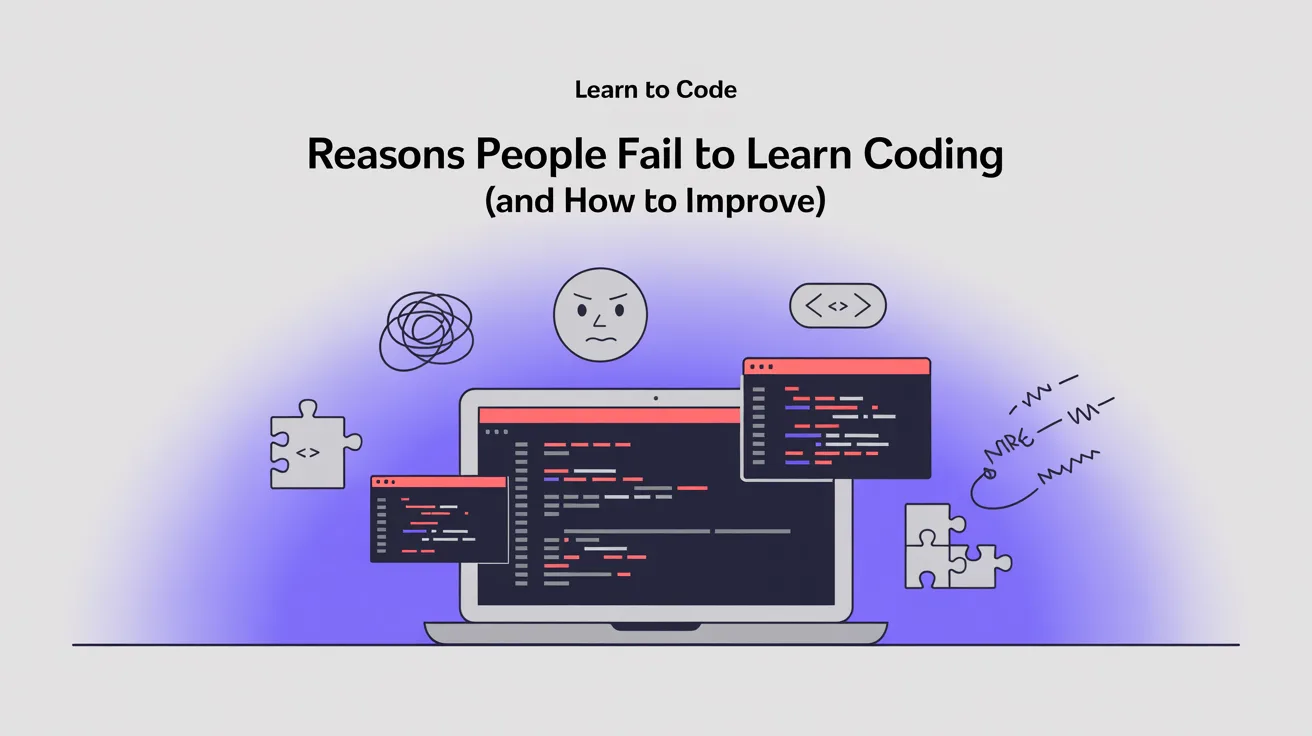
If you've tried before and stalled, read the most common reasons people fail to learn coding. Most of them come down to habits. None of them mean you lack ability.
Free resources to learn programming online
You can learn the fundamentals without spending a ringgit. These are the free sources I send my own students to:
- freeCodeCamp runs a full browser-based curriculum plus a large YouTube channel. It's good for web development from zero.
- The official Python tutorial at docs.python.org is dry but accurate. The people who maintain the language wrote it.
- MDN Web Docs from Mozilla is the reference working developers use for HTML, CSS and JavaScript. Their Learn section is beginner-friendly.
- MIT OpenCourseWare publishes real university computer science lectures and assignments for free.
The upside is obvious: zero cost, total freedom. The downside shows up around week four. Nobody tells you what to learn next, so you end up with gaps you can't see. You learn React before you understand functions. You copy a fix from a forum without knowing why it worked.
Free is a great way to find out whether you enjoy coding. It's a weak way to get job-ready fast, because nobody reviews your code and nobody notices when you quietly stop.
This article is one step. See the whole path for you.
What you learn matters less than learning it in an order that builds. Answer 7 questions and see the path that fits your goal, your level and the hours you have.
- What to focus on right now
- What you can safely ignore for now
- A first project at your level
- A weekly plan that fits your time
Free · About 2 minutes · We email you your roadmap
Already learning? Check where your skills are or build a small app
Online coding courses for beginners: when structure is worth paying for
Self-paced paid programs sit in the middle. You still study on your own schedule, but someone else has already decided the order of topics. That order is the thing free resources leave to you, and it's most of what you're paying for.
Before you hand over money, check for three things: projects you build yourself, a human who reads your code and tells you what's wrong with it, and a clear picture of what you can do when you finish.
Skip any course whose main selling point is hours of video. Video is the cheapest thing to produce and the least useful thing to buy.
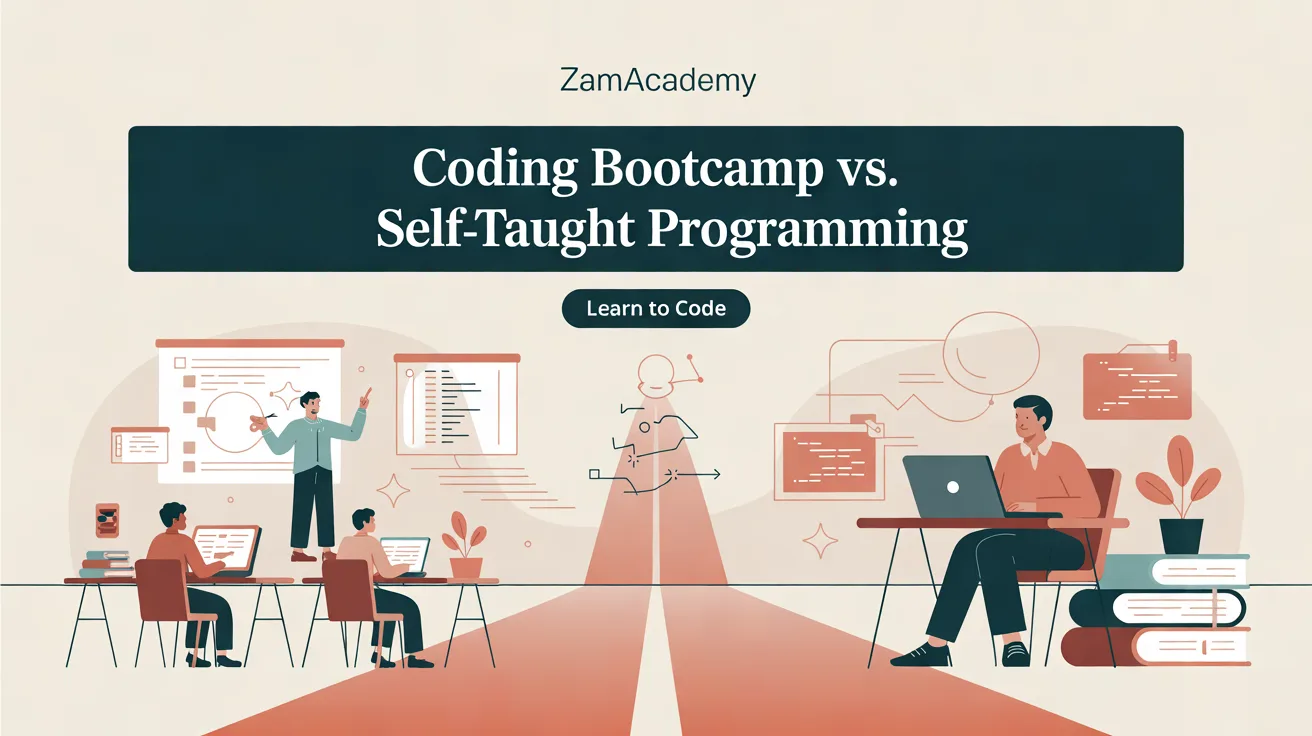
Live cohorts cost more and ask more of you. You get deadlines, classmates, and an instructor who notices when you vanish. For some people that pressure is the whole point. If you've started and stalled twice on your own, that tells you what you need. It isn't a character flaw. Our comparison of coding bootcamp vs self-taught programming lays out the tradeoffs.
How long does it take to learn coding?
Your weekly hours matter more than anything else. Full-time online bootcamps usually run about 12 to 24 weeks. Self-study takes longer, because almost nobody can give it full-time hours around a job.
Forty-five minutes a night adds up to about five hours a week. That's a slower road than a full-time program, but it's a real one if you don't skip weeks. If you want to see how hours translate inside a program, we broke down how many hours per week to dedicate to a coding bootcamp.
Also, stop waiting for a moment when you've "learned coding." It doesn't arrive. A better milestone: you can build a small thing without copying it line by line.
Your first two weeks, day by day
The best way to learn to code at home is boringly consistent. Same chair, same time, phone in another room.
Week one: one language, the basics. Pick Python if you want the gentlest start. Not sure what it's for? Read what Python is used for. If you want to build websites, start with HTML, CSS and JavaScript, and this breakdown of how the three differ will keep you from mixing them up.
- Days 1-2: install an editor and run your first program.
- Days 3-5: variables, conditionals, loops, functions. One concept per night.
- Weekend: rewrite what you learned from memory in a blank file. You'll get stuck. That's the point.
Week two: build something small. A tip calculator. A quiz. A to-do list. It should be a little embarrassing and it should work. Need ideas? Start with these first coding project ideas that are actually doable.
When you hit an error, write it in your stuck log before you search for the answer. Two weeks later, that log is your own personalized textbook.
Once your first language sticks, the second goes much faster. Here's how to learn a new programming language fast when you get there.
Use AI as a tutor, not a ghostwriter
Paste an error message into an AI assistant and ask it to explain what the message means. Don't ask it to fix your file. Then fix it yourself.
If you let it write every function, you'll feel fast for a week and lost in week five. Our guide to learning to code with AI shows how to use it without losing the skill you came to build.
Skip the course comparison tonight
Choose Python or JavaScript, open a blank file, and write ten lines that do something. Tomorrow, do it again.
If you'd rather have a path, a mentor and deadlines from day one, take a look at the ZAM Academy bootcamp.
Frequently asked questions
How many hours a day should I study to learn coding quickly?
Consistency matters more than length. Forty-five focused minutes every day beats one five-hour weekend session, because your brain consolidates new syntax between sessions. Even 30 minutes counts.
Should I learn more than one programming language at the start?
No. Commit to one language for at least eight weeks. Switching early, such as moving from Python to JavaScript in week three, resets most of your progress.
Can I learn to code for free online?
Yes. freeCodeCamp, the official Python tutorial, MDN Web Docs and MIT OpenCourseWare cover the fundamentals at no cost. The weak spot is structure, feedback and accountability.
Is it worth paying for an online coding course?
Free resources cover syntax well, so what you pay for is structure, feedback and accountability. A paid course helps most if you keep hitting gaps or stalling without anyone noticing.
How much of my study time should be spent writing code?
Spend at least half of each session typing code yourself. Watching others code builds recognition, which is a different skill from writing code. Aim for an hour of practice per hour of watching or reading.
Can I learn coding while working a full-time job?
Yes. Study at the same time each day, keep a log of errors and fixes, and tell one person your plan. Adults often do well because they are used to showing up when they don't feel like it.