Careers & pay7 min read
AI Engineer vs Software Developer Career: 2026 Pay Guide

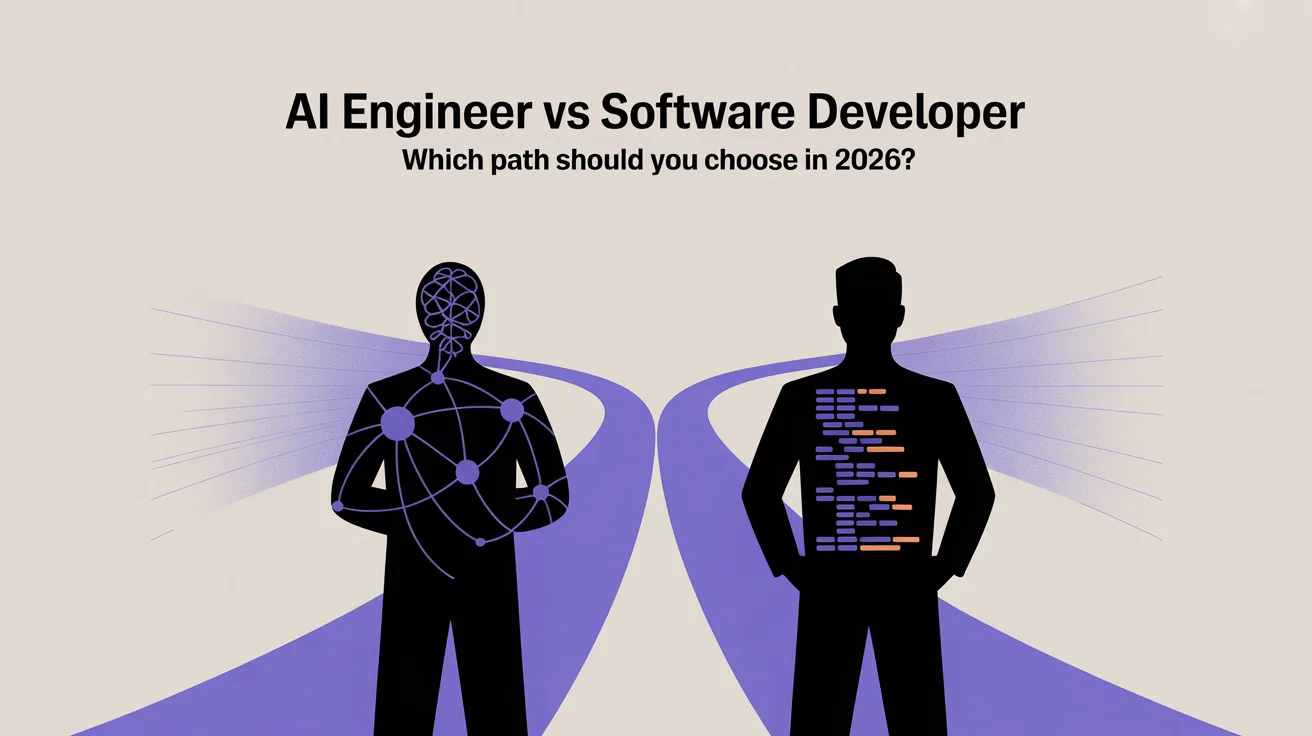
Start with software engineering fundamentals, then specialise into AI. That's my answer to the AI engineer vs software developer career question. Not because AI engineering is too hard for you, but because the fastest route into an AI job runs through the same skills a software developer needs.
I give this answer to almost every career-changer who asks me over a laptop at 9pm after a full day at work. Pretending otherwise costs people six wasted months. Here's the reasoning, the numbers behind it, and the strongest argument against me.
Key takeaways
- A software developer builds deterministic systems: same input, same output. An AI engineer builds probabilistic ones, where the same prompt can return two different answers and both are correct.
- Widely cited 2026 figures put software developers around USD 70k–130k and AI engineers at USD 120k–220k+, roughly a 12–28% premium. Those are global benchmarks, not Malaysian offers, so check local listings before you plan your life around them.
- Roughly 80% of an AI engineer's day is ordinary backend work: APIs, retries, data plumbing, tests. That is why the fundamentals come first.
- The most valuable profile in 2026 is neither specialist alone. It is the hybrid who ships a working product and wires the intelligent layer into it.
AI engineer vs software developer career: what actually differs day to day
A software developer builds the thing you tap on. The food delivery app, the bank's login flow, the admin dashboard nobody outside the company ever sees. You write code, you define the rules, and the system obeys them. Break a rule and you get a bug you can reproduce. That reproducibility is the whole comfort of the job.
Typical stack: JavaScript or Python, React on the front, Node or Django on the back, PostgreSQL or MongoDB underneath, Git and AWS holding it together. If you're still sorting out where the front end even begins, the difference between HTML, CSS and JavaScript is the right starting point.
An AI engineer builds software where part of the logic is learned rather than written. A support bot that reads your docs and answers customers. A system that reads 400 resumes and ranks them. A tool that turns a messy voice note into a structured order. The stack looks like Python (here's what Python is used for if it's new to you), an LLM API from OpenAI or Anthropic or Google, a framework like LangChain or LlamaIndex, a vector database like Pinecone or Weaviate, and a cloud ML platform such as Vertex AI or SageMaker.
The mindset shift is the part nobody warns you about. Here is the moment it lands for every student I've taught: they write their first test against an LLM response, assert that the output equals "Order confirmed", and the test fails. Not because their code is broken. Because the model said "Your order is confirmed!" this time. Deterministic thinking meets a probabilistic system, and the first casualty is your assumptions about what "correct" means.
You stop asserting exact strings. You start writing evaluations: does the answer contain the order ID, does it refuse when it should, how often does it hallucinate a price. That is a genuinely different engineering discipline, and it sits on top of normal code — it does not replace it.
AI engineer vs software developer salary: the premium is real, the context matters
The numbers doing the rounds for 2026 look like this:
| Software developer | AI engineer | |
|---|---|---|
| Typical salary band | USD 70k–130k | USD 120k–220k+ |
| Premium | baseline | ~12–28% higher |
| Demand | stable, every industry | very high, concentrated in AI-adopting firms |
| Path clarity | mature, well documented | fast-moving, still forming |
| Tools | React, Node, SQL | LangChain, LLM APIs, PyTorch |
Two honest caveats, because I'd rather you trust me later.
First, those are international figures, mostly US-weighted. Do not convert them to ringgit and set that as your expectation for a first job in KL. Open Jobstreet or LinkedIn, filter to Malaysia, read twenty actual postings, and build your own picture. That exercise takes an hour and is worth more than any salary blog post, including this one.
Second, the premium goes to people who have shipped something, not to people who finished a course on transformers. A junior who can demo a working retrieval-augmented chatbot with real evaluation numbers negotiates from a different position than a junior with certificates. Same as it ever was.
From learning to code to having work to show
Get a roadmap built around your goal and your week: the stage to focus on now, the projects that come next, and what you can safely leave for later.
- What to focus on right now
- What you can safely ignore for now
- A first project at your level
- A weekly plan that fits your time
About 2 minutes · No email needed · Beginner friendly
Already learning? Check where your skills are or build a small app
Which is easier to learn: AI engineering or software development?
Software development is easier to learn. Not easier to master — easier to learn, and the distinction matters when you're studying at night with limited energy.
Three reasons:
The feedback loop is instant and honest. Your button either changes colour or it doesn't. Your API either returns 200 or 401. When an AI feature underperforms, there's no red line telling you why. The model answered, the answer was mediocre, and you have to work out whether the prompt, the retrieved documents or the model is to blame. That takes judgment, and judgment takes reps.
The path is mapped. Software development has a well-worn curriculum: one language, version control, a database, a deployed project. AI engineering is still forming, so the tools you learn this quarter may look different next year. Fundamentals don't expire the same way.
Every AI skill sits on a software skill. Calling an LLM API is an HTTP request. Handling a failed call is error handling. Storing embeddings is a database problem. If those words feel fuzzy, you'll feel it the moment your chatbot times out and you don't know where to look.
If you're worried about the learning itself, read why people fail to learn coding before you pick a track. In my experience, quitting has less to do with the track than with how people study.
The strongest argument against starting with fundamentals
Here's the counter-argument, and it's a good one. LLM APIs mean you can build something impressive in a weekend without a computer science background. Why spend months on fundamentals when the shortcut works right now?
Because the weekend project is the easy part. The first time it breaks in front of a real user, you need to read a stack trace, inspect a network call and write a test. That's software developer work.
AI tools can speed up your learning, and learning to code with AI is a legitimate approach. But it speeds up the fundamentals. It doesn't skip them.
And if you've been watching tutorials for weeks without building anything, escape tutorial hell first. Pick one of these first coding project ideas and finish it.
Where the machine learning engineer fits
One more mix-up to clear. A machine learning engineer trains and tunes models: statistics, PyTorch, datasets, experiments. An AI engineer usually takes a model that already exists and builds a product around it.
Software developer vs machine learning engineer is the wider gap of the two, and a much steeper climb for a career-changer. If your goal is to ship products, the AI engineer route sits far closer to what you'd learn as a developer anyway.
So which one should you choose?
AI engineer job prospects for 2026 look strong on the figures above, but the demand is concentrated in companies already adopting AI. Developer roles are everywhere. That shapes the decision.
- You're starting from zero: aim at developer skills first, and build one AI project on top before you apply. That project is your proof.
- You already write Python or work with data: move toward AI engineering sooner. You have the base.
- You like testing behaviour and living with messy answers: AI engineering will suit you. If you need clean, predictable systems, stay on the developer side.
Either way, the hybrid wins. If you want to see what that role looks like in practice, read what an AI software engineer actually does. When you're ready to job-hunt, how to get a job after a coding bootcamp lays out a real roadmap.
Your next step
Open the ZAM Academy bootcamp page and check the syllabus against this post: fundamentals first, then an AI project you can demo. Not sure a bootcamp is right for you? Read whether an AI software engineer bootcamp is worth it first.
Frequently asked questions
Is an AI engineer just a software developer with extra skills?
Mostly yes. AI engineering sits on top of normal coding skills, since roughly 80% of the job is ordinary backend work like APIs, retries, and data plumbing.
Do AI engineers really earn more than software developers?
Widely cited 2026 figures put AI engineers around USD 120k-220k+ versus USD 70k-130k for software developers, a roughly 12-28% premium, but these are global, US-weighted benchmarks, not local offers.
Should I learn software development before AI engineering?
Yes. The article recommends starting with software engineering fundamentals and then specialising into AI, since the fastest route into an AI job runs through core developer skills.
Why is testing AI systems different from testing normal software?
You can't assert exact output strings because the same prompt can return different correct answers. Instead you write evaluations checking things like whether the answer contains the right info or hallucinates.
Which career is easier to learn, AI engineering or software development?
Software development is easier to learn, mainly because its feedback loop is instant and honest: a button either works or it doesn't, unlike judging AI output quality.
Does finishing an AI course guarantee the salary premium?
No. The premium tends to go to people who have shipped a working project with real evaluation results, not to those who only completed a course on the topic.