Careers & pay7 min read
AI Engineer vs Software Developer: Which Path Should You Choose in 2026?

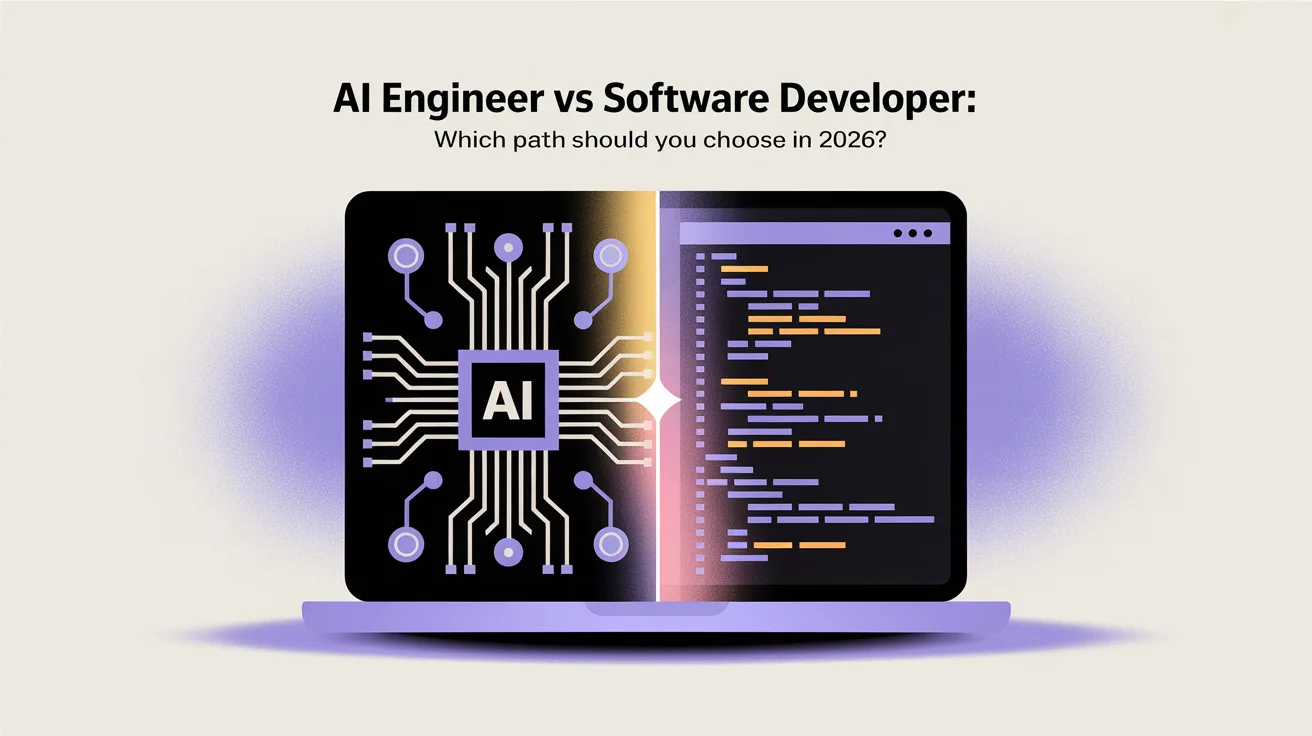
Start with software fundamentals, then specialise into AI. That's my answer after teaching hundreds of career-changers the AI engineer vs software developer career question. A developer builds systems where the same input always gives the same output. An AI engineer builds systems that predict and occasionally surprise you. You can't debug probabilistic code if you can't debug deterministic code first.
Key takeaways
- AI engineers command roughly a 12–28% pay premium over general software developers, with specialised roles reported in the US$120,000–$220,000+ range internationally; standard developer roles sit closer to US$70,000–$130,000.
- Both jobs share the same first 8–12 weeks of learning: Python or JavaScript, Git, APIs, databases, debugging. The split happens after that.
- "AI Engineer" ranked as the fastest-growing job title heading into 2025–26, but there are still far more junior software developer openings than junior AI ones — which matters if you need a job in six months, not three years.
- GitHub's developer survey reported 92% of developers already use AI coding tools, so AI literacy is no longer a specialisation. It's the baseline.
What a software developer actually does all day
You get a ticket. "Users can't update their delivery address after checkout." You reproduce the bug, trace it through three files, discover the API silently drops the field because someone typed adress in the payload, fix it, write a test, push, review a teammate's PR, go to standup.
That's the job. Not glamorous, deeply satisfying when it clicks.
The toolkit is well-worn: JavaScript or TypeScript, Python, Java, C#. React on the frontend. Node.js, Django or Spring on the backend. PostgreSQL or MongoDB for data. Git for everything. AWS or Azure to run it. If you're still figuring out where the pieces sit, the difference between HTML, CSS and JavaScript is the right place to begin.
The mindset is deterministic. You define the rules; the machine obeys. When something goes wrong, there is a reason, and you can find it. That certainty is genuinely comforting when you're learning.
What an AI engineer actually builds
Different ticket. "Our support bot keeps inventing refund policies that don't exist."
Now what? There's no line of code that says "invent policy." You look at the prompt. You look at what documents got retrieved from the vector database and notice the top match was a 2023 draft nobody deleted. You tighten the retrieval, add a system instruction that forbids answering outside the retrieved context, run it against 50 test questions, and accept that you got hallucinations down rather than to zero.
The tools: Python, almost always. LLM APIs from OpenAI, Anthropic or Google. Frameworks like LangChain or LlamaIndex to wire models to your data. Vector databases like Pinecone or Weaviate. Cloud ML platforms like Vertex AI or SageMaker. The OpenAI API documentation is where most people's first AI feature actually gets written.
The mindset is probabilistic. Same input, slightly different output, by design. You stop asking "is it correct" and start asking "is it correct often enough, and what happens when it isn't." If that distinction is new to you, AI agents vs chatbots unpacks it with concrete examples.
AI engineer vs software developer career: the differences that matter
| Software developer | AI engineer | |
|---|---|---|
| Core mental model | Rules and logic | Probability and evaluation |
| Main language | JavaScript, Python, Java | Python, overwhelmingly |
| Typical stack | React, Node.js, SQL | LLM APIs, LangChain, PyTorch, vector DBs |
| Reported salary range | US$70k–$130k | US$120k–$220k+ |
| Junior openings | Many, across every industry | Fewer, often expect prior dev experience |
| Path maturity | Twenty years of documentation | Best practices change every few months |
The row that decides most people's choice isn't salary. It's "junior openings."
From learning to code to having work to show
Get a roadmap built around your goal and your week: the stage to focus on now, the projects that come next, and what you can safely leave for later.
- What to focus on right now
- What you can safely ignore for now
- A first project at your level
- A weekly plan that fits your time
Free · About 2 minutes · No signup
Already learning? Check where your skills are or build a small app
AI engineer vs software developer salary: what the numbers hide
The premium is real. Reported ranges put AI engineers 12–28% above comparable developer roles, and specialised LLM work goes higher.
Two caveats, and they matter more than the headline.
First, those figures are international benchmarks in US dollars. Malaysian packages are different, and I'm not going to hand you a made-up ringgit number. Check MYFutureJobs and current LinkedIn listings in KL for the roles you actually want; that's a truer signal than any blog salary table, including this one.
Second, that premium is almost never paid to someone in their first job. It's paid for judgment: knowing when RAG beats fine-tuning, how to cut token costs, what to do when latency triples in production. Judgment takes projects, and projects take a first job. The salary gap is a mid-career gap, not a starting-line gap.
Which is easier to learn: AI engineering or software development?
Here's the trap. Building your first AI feature is easier than building your first full-stack app. Twenty lines of Python, an API key, and you have a working chatbot. It feels like a shortcut.
Then it breaks, and nothing you know explains why.
I've watched this play out with dozens of students. They wire up a chatbot in a weekend using a tutorial, ship it to a friend's small business, and feel unstoppable for about a week. Then it starts quoting the wrong return policy to actual customers, and they have no idea where to even start looking, because they've never had to debug anything that didn't come with a script telling them where the bug lives.
Software development is harder to start and easier to verify. Your React component either renders or it doesn't. The error message points at a line. You learn to read stack traces, and progressively the machine stops being a mystery.
AI engineering is easier to start and much harder to verify. Your output looks plausible and is wrong. There's no stack trace for "the model was confidently incorrect." To debug it you need to already be comfortable with HTTP, JSON, async calls, environment variables and reading logs — all of which are software development skills.
So the honest answer: AI engineering has a lower floor and a steeper ceiling. Beginners who skip the floor end up gluing tutorial code together without understanding it, which is exactly how tutorial hell happens.
Learn Python properly first. What Python is actually used for covers why it's the one language that serves both paths.
AI engineer job prospects 2026
Demand is genuinely strong and genuinely lopsided.
Every company with a product now wants an AI feature. Most of them do not want to hire an AI research team; they want someone who can ship a retrieval pipeline, wire it to their existing data, and keep the cost per query sane. That's an engineering job, not a research job, and it's why so many AI engineer postings ask for two or three years of general software experience before they'll even look at your AI projects.
Which brings me back to where I started. I've watched career-changers try to skip the developer stage entirely and land an "AI engineer" title straight out of a bootcamp. A few pull it off. Most spend six frustrating months applying to roles that quietly expect the fundamentals nobody taught them.
Build the developer foundation first — Git, APIs, databases, a debugger you're not afraid of. Specialise into AI once code that doesn't behave the way you expect stops scaring you. If you want that foundation built properly instead of guessed at, that's what our bootcamp is built to do.
Frequently asked questions
Do I need a computer science degree to become an AI engineer?
The article doesn't require one. It recommends learning Python and software fundamentals first, then specialising into AI engineering skills like LLM APIs and vector databases.
How long does it take to learn the basics before specialising?
Software developer and AI engineer paths share the same first 8-12 weeks: Python or JavaScript, Git, APIs, databases and debugging. The split happens after that.
Is it harder to get a junior AI engineering job than a junior developer job?
Yes. There are far more junior software developer openings than junior AI engineering ones, and AI roles often expect prior development experience.
Will AI coding tools replace the need to learn software development?
No. GitHub's developer survey found 92% of developers already use AI coding tools, so AI literacy is now a baseline skill, not a replacement for fundamentals.
Why does AI engineering pay more than general software development?
The premium is mostly paid for judgment gained over time, like knowing when to use RAG versus fine-tuning or how to cut token costs, not for entry-level work.
Is AI engineering actually easier to learn than software development?
It's easier to start, since a basic chatbot can be built in a few lines of code, but much harder to debug and verify because outputs can look correct while being wrong.