Careers & pay5 min read
Coding Bootcamp with Certificate: Is It Worth It? (2026)

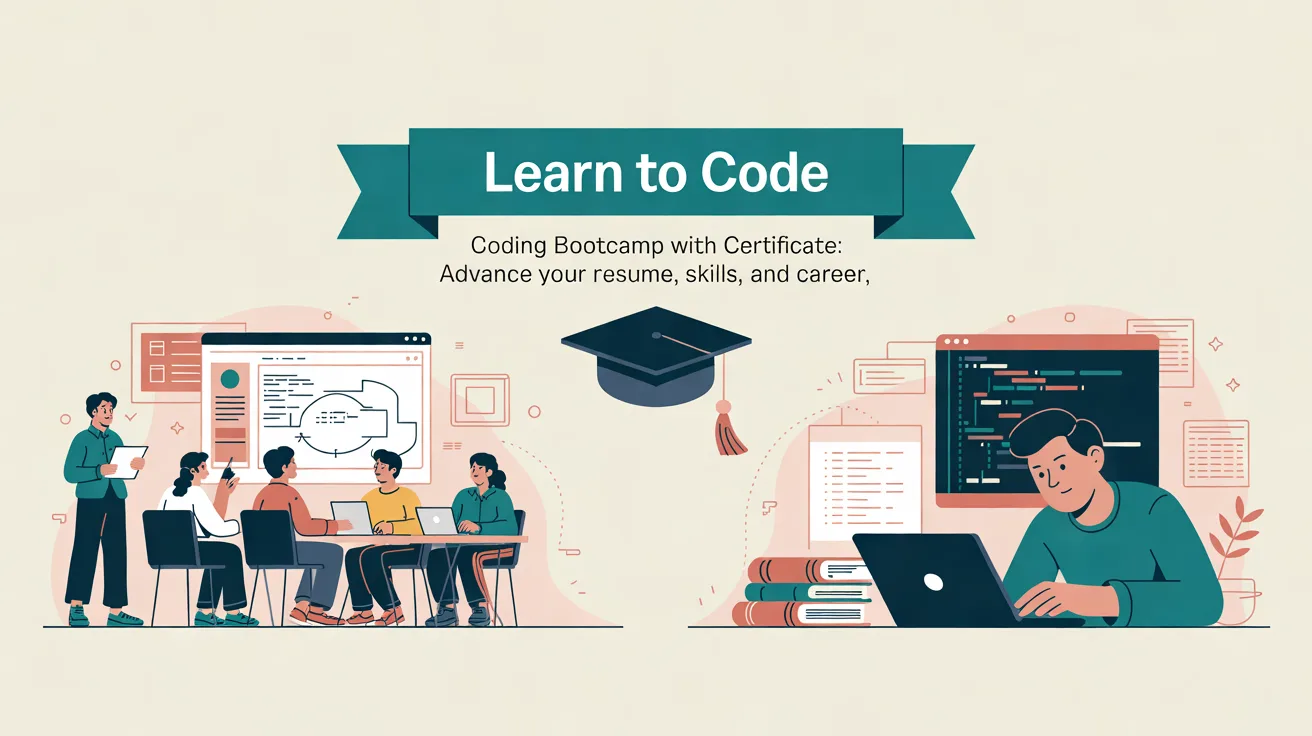
A coding bootcamp with certificate gives you proof you finished, not proof you can do the job. The certificate gets you a second look. The portfolio you built while earning it gets you hired. Pick a bootcamp for what you can show a hiring manager at the end, and the certificate becomes a useful extra line on your resume.
Key takeaways
- A bootcamp certificate shows you finished a structured programme. Employers still decide mostly on your projects, your GitHub, and how you handle a technical interview.
- Bootcamps can run as short as three months, against the three to four years of a typical degree. That gap matters most when you're 30 with rent to pay.
- The US Bureau of Labor Statistics still lists a bachelor's degree as the typical entry-level education for software developers. Some doors stay harder to open without one, and you should plan for that.
- The certificate goes in an Education or Training section. Two or three deployed projects with live links go higher up the page.
Do coding bootcamps give a certificate?
Most do. You finish the curriculum, pass the assessments or the final project, and you get a certificate of completion. It names the programme and usually the stack you learned: full-stack web development, front-end, back-end, data analytics, or, increasingly, AI-assisted software development.
Here's the part nobody explains clearly. A bootcamp certificate is usually not a government-recognised qualification like a diploma or degree. It's a private credential. Its value comes from the school's reputation and the work you can show next to it.
That's not a weakness to hide. But you should know it before you pay, so you judge a programme by the right yardstick.
Does a coding bootcamp certificate help your resume?
Yes, a little. And "a little" matters more than it sounds.
Picture a recruiter with 200 applications for a junior developer role. They give each one a few seconds. Your resume says you spent six years in accounting, and nothing on it says "developer." The certificate is the line that explains the jump. It tells them you didn't watch a few YouTube videos over a weekend. You finished a demanding programme with deadlines and assessments.
What it signals:
- You can finish things. Career-switching is mostly a test of stamina, and employers know it.
- Your skills are current. A recent certificate in a modern stack reads better than "self-studied JavaScript, 2019–present."
What it doesn't do is pass the technical interview for you. Nobody in that room will ask to see the PDF. They'll ask why your useEffect runs twice, or how you'd structure a database for a booking app.
Here's roughly how I tell students to lay it out:
PROJECTS
Kedai Booking App · React, Node.js, PostgreSQL · live link · GitHub
  - Built table reservations with email confirmation for a real café
  - Cut page load from ~4s to under 1s by paginating the menu query

TRAINING
Full-Stack Software Development Bootcamp, ZAM Academy · 2026
Projects lead. The certificate backs them up. The order is deliberate. For the full breakdown, read our guide on how to put a coding bootcamp on your resume.
From learning to code to having work to show
Get a roadmap built around your goal and your week: the stage to focus on now, the projects that come next, and what you can safely leave for later.
- What to focus on right now
- What you can safely ignore for now
- A first project at your level
- A weekly plan that fits your time
Free · About 2 minutes · No signup
Already learning? Check where your skills are or build a small app
Picking a coding bootcamp with certificate value that lasts
A certificate is only worth as much as the training behind it. I get opinionated here, because I've seen people pay for programmes that hand out certificates like attendance stickers.
Check these before you enrol:
- The curriculum matches real job ads. Open ten junior developer listings in Kuala Lumpur, or wherever you want to work. Write down the technologies. Then hold that list up against the syllabus. In 2026, a modern programme should cover APIs, databases, Git-based teamwork and AI-assisted development workflows. If it stops at HTML and jQuery, walk away.
- You ship real projects. I mean deployed apps with a live URL that a stranger can click, not slides about projects. GitHub Pages and similar free hosts make this easy, so a programme that skips it has no excuse.
- A human reviews your code. An automated quiz can't tell you your function is 80 lines long and should be four functions. A mentor can.
- The school is honest about outcomes. Ask how graduates found jobs. If the answer is vague marketing, count it as a no.
The certificate should be the receipt for all of that. If it arrives without the work behind it, it's just paper. Hold the ZAM Academy bootcamp up against this same list and judge it the way you'd judge any other.
Bootcamp vs degree vs self-taught: the numbers that matter
| University degree | Bootcamp | Self-taught | |
|---|---|---|---|
| Typical time | 3–4 years full-time | A few months, as short as ~3 | Open-ended, often years |
| Credential | Recognised degree | Certificate of completion | None |
| Focus | Theory plus broad coursework | Job-ready practical skills | Whatever you happen to pick |
| Structure and feedback | High | High | You supply it yourself |
| Cost | Usually highest | Usually lower than a degree | Lowest in money, highest in time |
Self-teaching works. I know excellent developers who did it. But most people who try it alone after work stall around month two, stuck in the loop I describe in escaping tutorial hell. Structure is what a bootcamp actually sells. The certificate proves you went through it. We compare the two paths in detail in coding bootcamp vs self-taught programming.
The strongest objection: "It's not a real qualification"
I'll take this one seriously, because it's partly right.
Some employers filter on degrees. Large corporates, government-linked companies and certain multinationals sometimes run HR systems that screen out anyone without one before a human reads the resume. The US Bureau of Labor Statistics lists a bachelor's degree as the typical entry-level education for software developers. That's American data, but the pattern holds in plenty of Malaysian hiring too.
A bootcamp certificate won't get you past a hard degree filter. Pretending otherwise would be lying to you.
But look at who hires career-changers in practice: startups, agencies, product companies, and the tech teams inside non-tech businesses. Those teams mostly care whether you can do the work. They give take-home tests, they read your GitHub.
Frequently asked questions
Is a coding bootcamp certificate a recognised qualification?
Usually not. It is a private credential, not a government-recognised diploma or degree. Its value depends on the school's reputation and the projects you can show alongside it.
Where should I put a bootcamp certificate on my resume?
Put it in an Education or Training section. Place two or three deployed projects with live links higher up the page, since employers weigh your projects more than the certificate.
Will a bootcamp certificate get me past a degree requirement?
No. Some large corporates, government-linked companies and multinationals screen out applicants without a degree before a person reads the resume. Startups, agencies and product companies are usually more flexible.
How do I check that a coding bootcamp certificate is worth paying for?
Compare the syllabus with real junior developer job ads, and look for deployed projects, human code review, and honest answers about how graduates found jobs.
How long does a coding bootcamp take compared with a degree?
Some bootcamps run as short as three months. A typical university degree takes three to four years of full-time study.
Do employers ask to see a bootcamp certificate in interviews?
Rarely. Interviewers are more likely to ask technical questions, such as how you would structure a database for a booking app, and to look at your projects and GitHub.